|
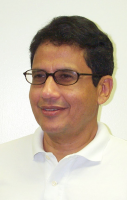
Mohamed Gouda (Texas)
Using Formal Methods in Network Research? What a Beautiful Idea!
Abstract: There are two types of benefits that result from
using formal methods in network research: short-term and
long-term. The short-term benefits are rather obvious. After all
formal methods have been widely used for several decades in
specifying, designing, verifying, implementing, and debugging network
protocols. However, the long-term benefits of using formal methods in
network research are decidedly subtle. Rather than merely establish
the correctness of a single protocol, formal methods can be employed
to deepen our understanding of large classes of protocols. We attempt
to make this point clear by discussing some results that we obtained
recently from our work in developing a new logic for designing and
verifying network firewalls.
Bio: Mohamed G. Gouda received his first B.Sc. in Aeronautical
Engineering and his second in Mathematics; both from Cairo University,
Egypt. He then obtained an M.A. in Mathematics from York University
and a Master and Ph.D. in Computer Science from the University of
Waterloo, Canada. Later he worked for the Honeywell Corporate
Technology Center in Minneapolis 1977-1980. In 1980, he joined the
University of Texas at Austin where he currently holds the Mike
A. Myers Centennial Professorship in Computer Sciences. He spent one
summer at Bell labs in Murray Hill, one summer at MCC, Inc. in Austin,
and one winter at the Eindhoven Technical University in the
Netherlands. Since 2009, he serves as Program Director of the Computer
Systems Research Program in the National Science Foundation.
His research areas are distributed and concurrent computing and
network protocols. In these areas, he has been working on abstraction,
formality, correctness, non-determinism, atomicity, reliability,
security, convergence, and stabilization. He has published three
books, over twenty book chapters, over one hundred journal papers, and
over one hundred and fifty conference papers.
He supervised twenty three Ph.D. Dissertations. Five of his former
Ph.D. students are now Full Professors at the University of Colorado
at Colorado Springs, the University of California at Santa Barbara,
the University of North Carolina at Chapel Hill, Ohio-State
University, and the University of Iowa. Another four of his former
students are now Associate Professors, and two of his former students
are still Assistant Professors in the U. S.
|
|
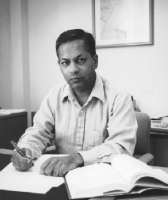
Jayadev Misra (Texas)
Structured Orchestration of Data and Computation
Abstract: This talk will describe our attempt at integrating
data and services within a large organization, or using the
internet. We have developed a theory, called Orc, in which we specify
the sources of data and computations and how to orchestrate their
executions (concurrently, one after the other, only when the majority
of data is available, ...). The Orc programming language has a very
small kernel, using external libraries of sites for support
functions. The language starts with concurrency as the defining
characteristic of programs. With its hierarchical and recursive
combination facilities, it provides a model of structured
concurrency. It can be used to orchestrate a small application or a
giant one with many millions of threads, running in real time, from
milliseconds to months. We have developed an experimental
implementation of the language. The language, its documentation, and a
web-interface are available at orc.cres.utexas.edu
where programs can also be submitted for execution.
Bio:
Jayadev Misra is a professor and holder of the Schlumberger Centennial
chair in Computer Science at the University of Texas at Austin. He is
known for his work in the area of concurrent programming, with emphasis
on rigorous methods to improve the programming process. His work on
the UNITY methodology, jointly with Chandy, has been influential in
both academia and industry, and has spawned a large number of tools
and research projects. He has recently developed a programming
language, called "Orc", for concurrent orchestrations of interacting
components. He is also spear-heading an effort, jointly with Tony
Hoare, to automate large-scale program verification.
Misra is a fellow of ACM and IEEE; he held the Guggenheim fellowship
during 1988-1989. He was the Strachey lecturer at Oxford University in
1996, and has held the Belgian FNRS International Chair of Computer
Science in 1990. He is a member of the Academy of Distinguished
Teachers at the University of Texas at Austin.
Misra has been the past editor of several journals including: Computing
Surveys, Journal of the ACM, Information Processing Letters and the
Formal Aspects of Computing. He is the author of two books, "Parallel
Program Design: A Foundation", Addison-Wesley, 1988, co-authored with
Mani Chandy, and "A Discipline of Multiprogramming", Springer-Verlag,
2001.
|